Acoustic diffuser well-depth calculator
Well depths for a cuttable quadratic-residue sound diffuser panel
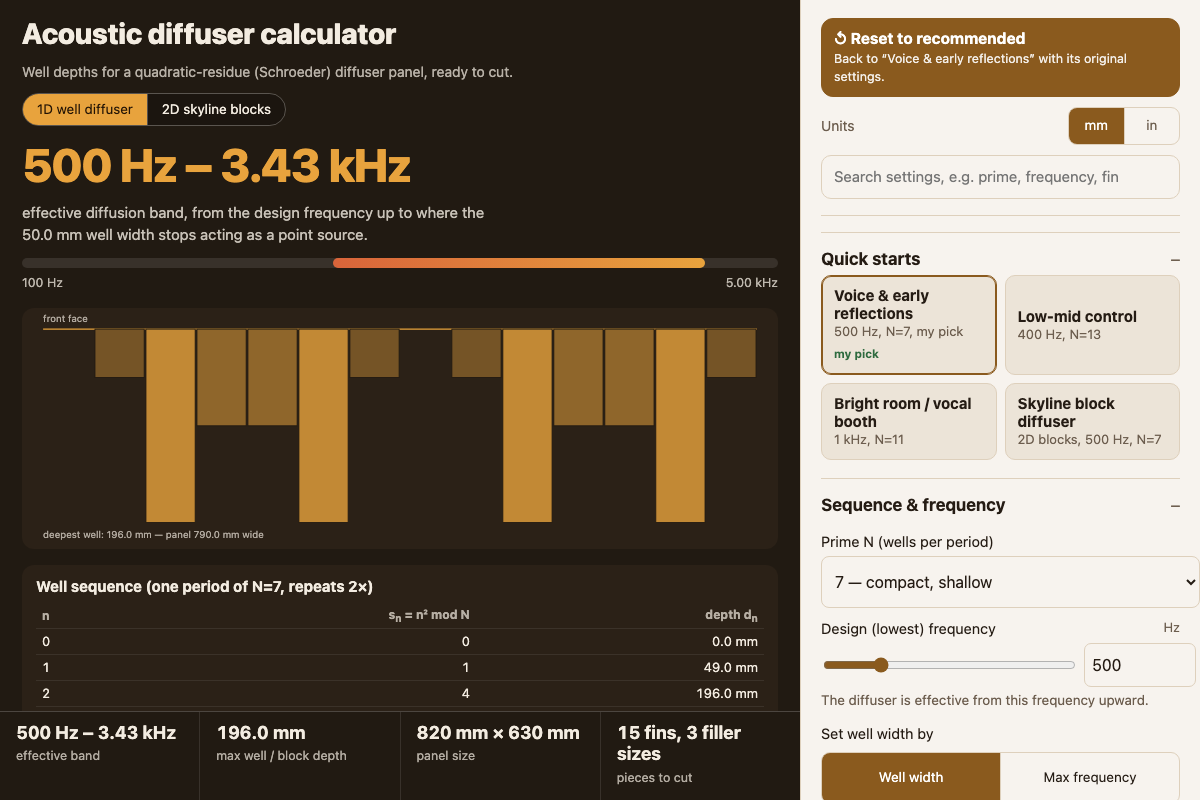
Screenshot of the tool as it opens; it is a real capture, not a mockup.
Thanks, your report was sent.
Report a problem or a newer version
What it makes
A table of well depths (1D mode) or block heights (2D skyline mode) for a quadratic-residue acoustic diffuser built from a chosen prime N, design frequency and well width, plus the effective frequency band the panel covers. Exports a cut list PDF with part sizes and quantities for the fins, filler blocks and back panel (or the block heights and counts for the skyline version), and SVG/DXF templates with laser/CNC-standard colours for the back panel and the flat pieces.
How to use it
- Start from a quick start — voice and early reflections (the default), low-mid control, a bright room or vocal booth, or the 2D skyline block version — or set your own prime, frequency and width.
- Pick a prime N (7, 11, 13 or 17), the design frequency you want the diffuser effective from, and either the well width or the top frequency you want it to reach.
- Set the fin thickness (1D mode), back panel thickness, panel height and how many times the sequence repeats across the panel.
- Check the stats bar and warnings for well depth, panel size and piece count before cutting.
- Download the cut list PDF for part sizes and quantities, and the SVG/DXF for the flat back panel, fin and filler (or block) outlines.
Build notes
- 1D well depths follow d_n = s_n·λ0/(2N) with s_n = n² mod N and λ0 = speed of sound ÷ design frequency; the 2D skyline heights use s(i,j) = (i²+j²) mod N. Source: T.J. Cox & P. D'Antonio, "Acoustic Absorbers and Diffusers."
- The lower edge of the effective band is the chosen design frequency; the upper edge is capped by well width (f_max ≈ speed of sound ÷ (2 × well width)).
- Construction assumes a flat front face: fins run full depth to the deepest well, and shallower wells get a filler block glued at the back so the front stays flush. The skyline version glues blocks of the mapped height onto a flat backer.
- Works fully offline once opened; nothing is fetched.