Dust collection fitting maker
Printable adapters between any two dust hoses or tool ports, as an STL
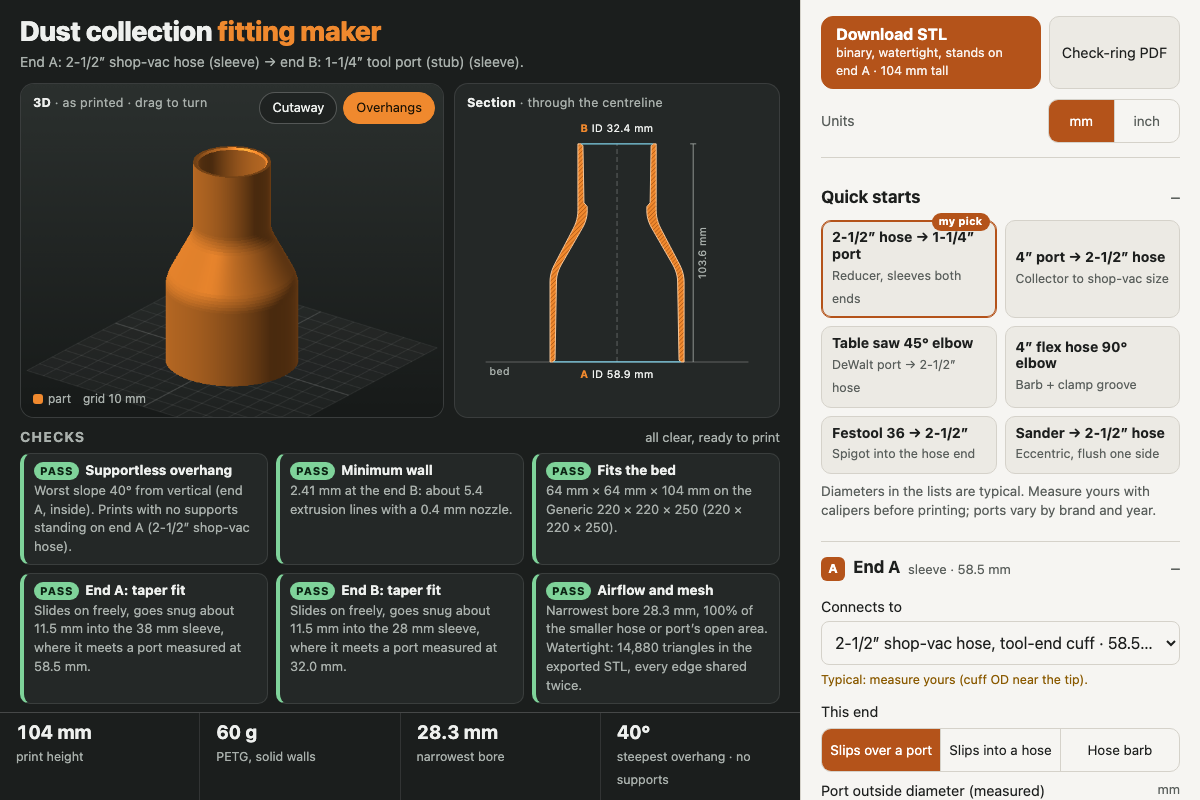
Screenshot of the tool as it opens; it is a real capture, not a mockup.
Thanks, your report was sent.
Report a problem or a newer version
What it makes
A watertight binary STL of a dust collection adapter, already standing in the orientation that prints with the fewest supports, and a 1:1 PDF with a measure-check ring for each end (plus a paper pi-tape for ports) so the diameters can be confirmed before printing. The live view shows the part in 3D on the print bed, with any faces that need support in red, a section through the centreline, and a Checks panel that passes or fails the overhang, minimum wall, bed fit, taper grip at each end, and airflow.
How to use it
- Pick a quick start, or choose what each end connects to from the list; its diameter is a typical value, so measure yours with calipers and type it in.
- Set each end as a sleeve over a port, a spigot into a hose, or a hose barb, then its engagement length, clearance and taper. The readout says how far in the taper goes snug.
- Set the wall thickness and, if needed, an offset or an elbow angle.
- Pick your printer bed and nozzle under Printer, and read the Checks until everything passes.
- Download the check-ring PDF, print it at 100%, and confirm both diameters against your hose and port.
- Download the STL and print it as it stands, in PETG for choice.
Build notes
- Preset diameters are typical measured values and vary by brand and year; every one is labelled to measure your own.
- Tapers default to 1° per side for sleeves and spigots, close to common shop-vac cuffs. With 0.4 mm clearance the fit goes snug about 11 mm in.
- Straight and offset fittings print with no supports. Elbows of 45° or more usually need supports, and the Checks say so.
- The mesh is built by sweeping rings along the centreline, with no CSG library. The Checks confirm every edge is shared by exactly two triangles.
- Works fully offline once opened; nothing is fetched.
Versions
The site runs the newest. Every earlier version stays downloadable, unchanged, for builds already under way.