Fret slotting template
Full-size fret slotting templates for straight or fanned fretboards
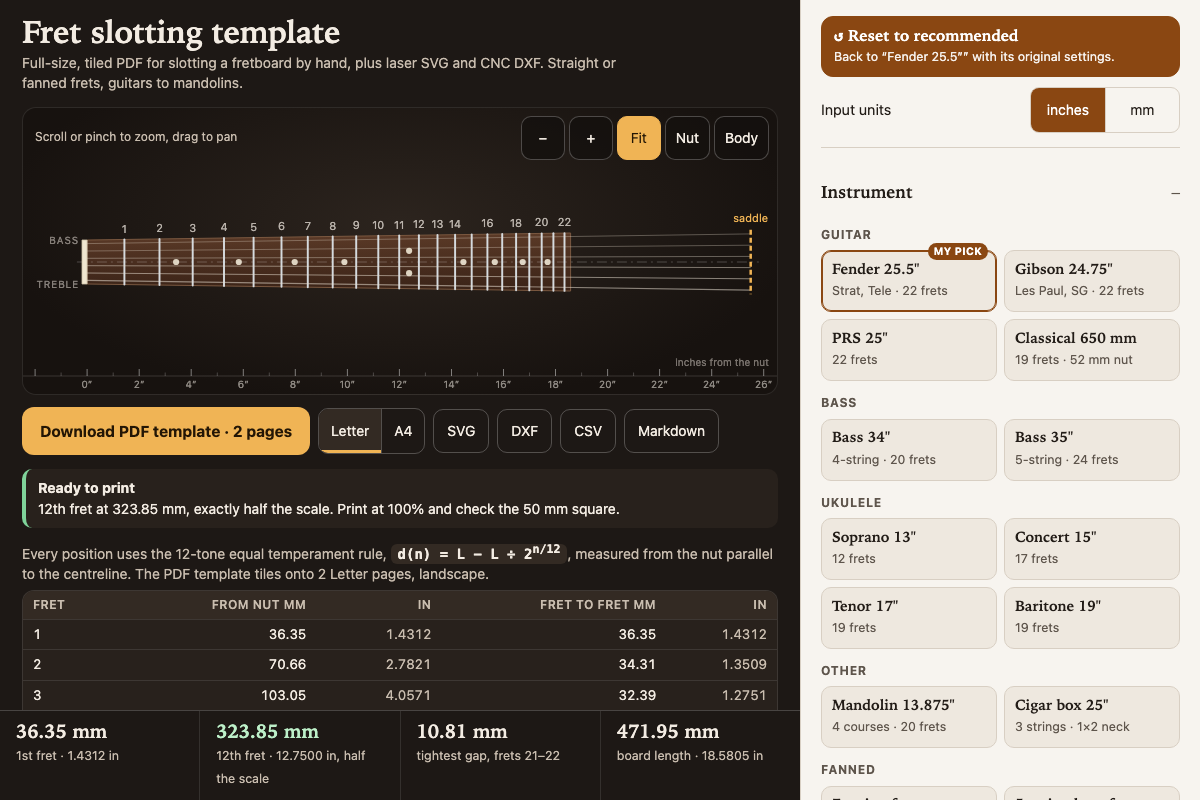
Screenshot of the tool as it opens; it is a real capture, not a mockup.
Thanks, your report was sent.
Report a problem or a newer version
What it makes
A fret slotting template drawn at full size: fret lines, the nut line, the centreline, the board outline, inlay marker centres and stroked fret numbers. The PDF tiles across Letter or A4 pages with grey overlap bands, lettered alignment marks, a 50 mm check square on every page and a page map. The same board comes out as a 1:1 SVG (blue score lines for fret positions, optional red cut outline) and an R12 DXF in millimetres with one layer per feature. A table lists every fret's distance from the nut and from the fret before, in millimetres to 0.01 and inches to 0.0001, plus the uncompensated saddle position.
How to use it
- Pick an instrument: Fender 25.5 in, Gibson 24.75 in, PRS 25 in, 34 or 35 in bass, 650 mm classical, soprano, concert, tenor or baritone ukulele, mandolin, cigar box guitar, or a fanned 7-string or bass.
- Or set your own scale in inches or millimetres and the number of frets. For fanned frets, tick Multiscale and set the bass scale, the treble scale and the fret that sits square to the centreline.
- Set the board width at the nut and at the last fret, the string count, the distance from the outer strings to the edge, and how far the board runs past the last fret.
- Read the warnings: a fan steeper than about 20 degrees, or fret spacing under 9 mm near the body (under 12 mm on scales shorter than 600 mm), are flagged in plain language.
- Download the PDF, print at 100% (Actual size), and measure the 50 mm square. Trim each page on its dashed edge, match the lettered marks, tape, and glue the template to the blank.
- For a laser or CNC, download the SVG or DXF instead. Score the blue lines at low power and cut the red outline if you want the board shape.
Build notes
- Distances use d(n) = L - L / 2^(n/12), measured from the nut parallel to the centreline. The 12th fret falls at exactly half the scale; on a 25.5 in scale the 1st fret is 1.4312 in (36.35 mm).
- On a fanned board each scale is measured along its outer string; frets are straight lines between the two strings, carried to the board edges.
- Saddle positions are uncompensated. Add compensation at the bridge as usual.
- Laser scoring marks positions only; cut the slots to depth with a fret saw or slitting cutter.
- Works fully offline once opened; nothing is fetched.
Versions
The site runs the newest. Every earlier version stays downloadable, unchanged, for builds already under way.