Hydronic emitter sizing calculator
Size fin-tube baseboard, panel or cast-iron radiators for each room's heat load
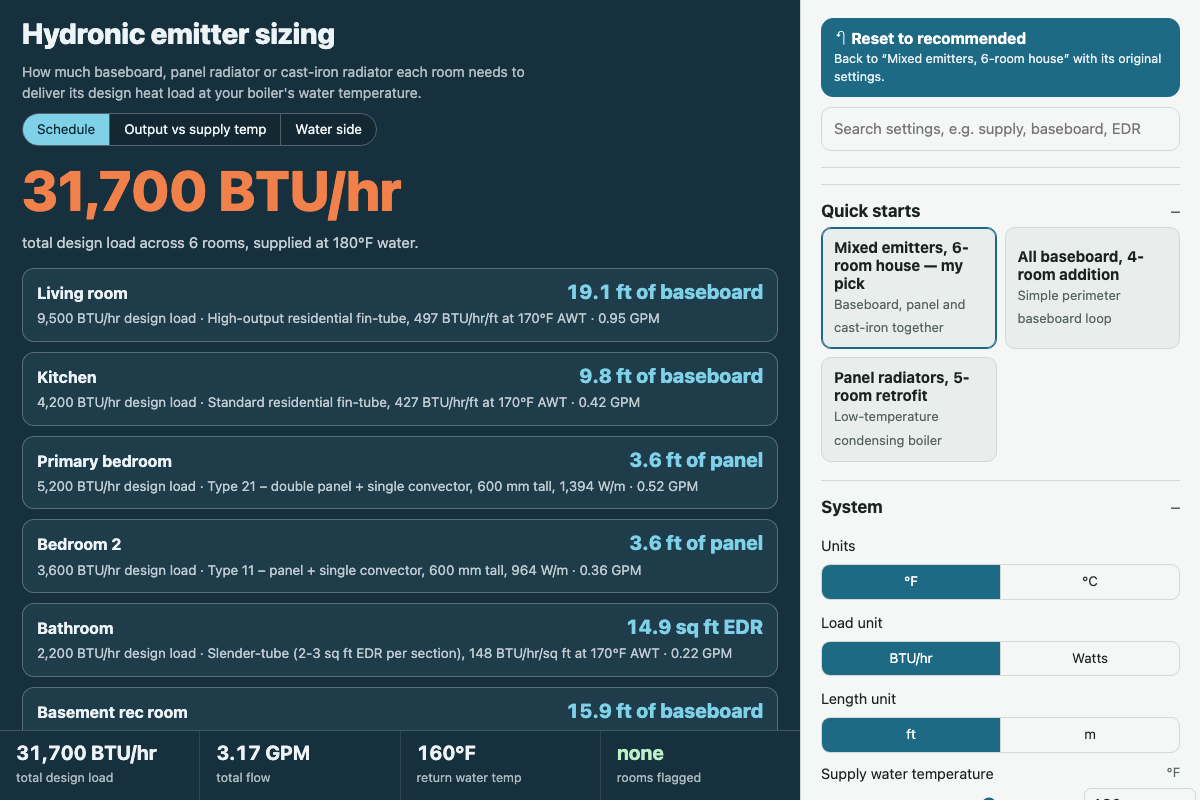
Screenshot of the tool as it opens; it is a real capture, not a mockup.
Thanks, your report was sent.
Report a problem or a newer version
What it makes
A per-room emitter schedule: the length of fin-tube baseboard, the panel radiator type/height/length, or the square feet of cast-iron EDR needed to deliver each room's design heat load at the chosen supply and return water temperature, plus flow rate per room and for the whole system (GPM, or L/min in metric). A second view charts how the sized system's output changes if the supply temperature moves, showing the lowest supply temperature the installed emitters can still keep up with. Download the schedule as Markdown or PDF, or the full inputs and results as JSON.
How to use it
- Start from a quick start (mixed emitters, all-baseboard addition, or low-temperature panel retrofit) or build your own room list.
- Set the supply water temperature and either the temperature drop across the emitters or the return temperature directly, plus the default indoor design temperature panel radiators correct against.
- Add each room with its design heat load and pick its emitter: fin-tube baseboard element, panel radiator type and height, or cast-iron radiator style; any room can override the indoor design temperature individually, e.g. for an unheated garage.
- Read the Schedule view for required lengths/areas and flow, check Output vs supply temp for how the system behaves away from the design point, and Water side for combined flow and return temperature.
- Download the schedule or save settings; import a heat-load-calculator settings file to pull in its total load, and its indoor design temperature, as a new room.
Build notes
- Fin-tube baseboard output is scaled from its 180°F AWT, 1 GPM, 65°F entering-air I=B=R-style rating using a (temperature difference)^1.3 exponent; entering air is taken as the room's indoor design temperature minus 5°F, which reproduces the published rating exactly at a 70°F room and credits a colder room with more output per foot. Manufacturer catalogs vary, so confirm against the specific element.
- Panel radiator output follows EN 442-2: Q = Q50 × (ΔT_lm / ΔT_lm,rated)^1.3, where ΔT_lm is the log-mean temperature difference to the room's own indoor design temperature and ΔT_lm,rated is the log-mean of EN 442's 75/65/20°C rating point itself (about 49.8 K — EN 442 calls it ΔT50 by convention, but the literal log-mean of that rating point isn't exactly 50); the W/m figures offered are typical of common compact-radiator ranges, not any one manufacturer's exact catalog.
- Cast-iron EDR uses the Hydronics Institute's 240 BTU/hr per sq ft steam rating at 215°F with a 70°F room, scaled by (AWT − room indoor design temperature) so it reproduces that rating exactly at a 70°F room; actual section output varies by radiator style and age.
- Works fully offline once opened; nothing is fetched.