Speaker post mount for threaded bosses
Printable speaker post mount that bolts into a keyboard's monitor bosses
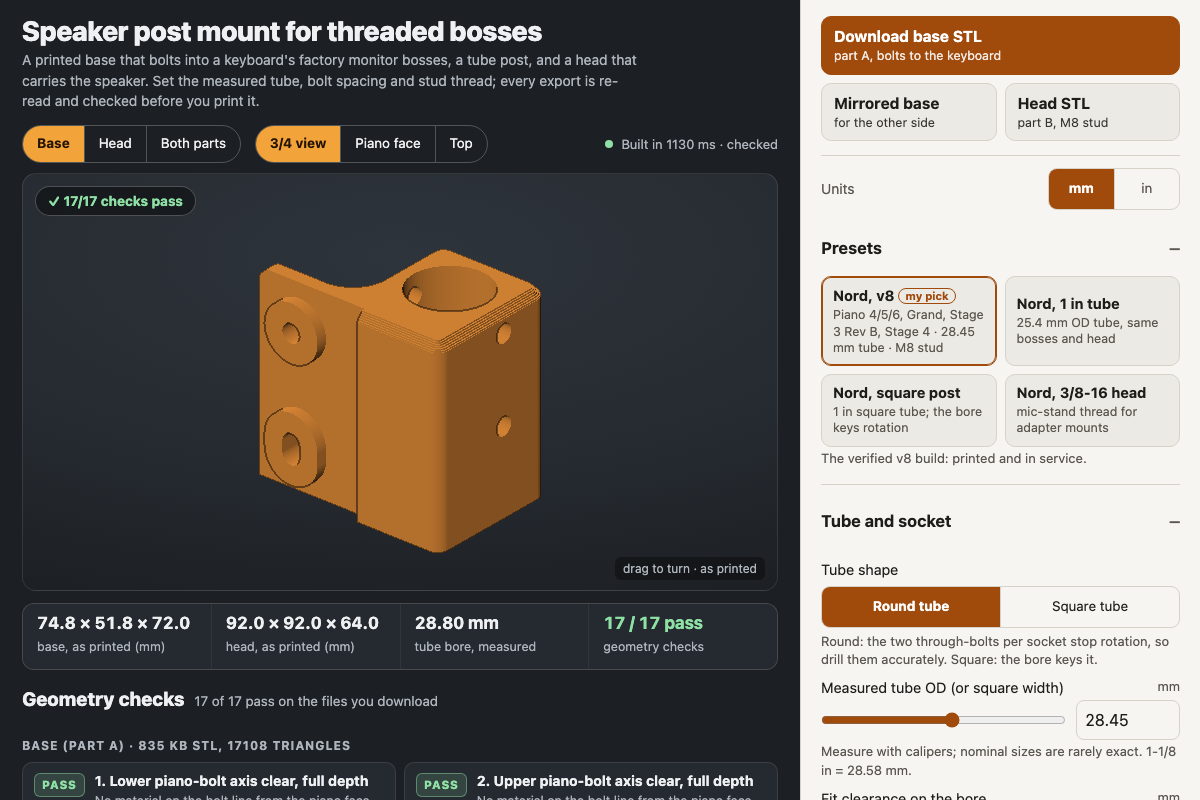
Screenshot of the tool as it opens; it is a real capture, not a mockup.
Thanks, your report was sent.
Report a problem or a newer version
What it makes
Binary STL files for a post-and-head speaker mount: part A, a base that bolts into a keyboard's two threaded monitor bosses with a blind socket for the tube (plus a mirrored copy for the other side), and part B, a round head with a conical skirt, a matching socket and a hex pocket for a captive speaker stud (M6, M8, M10 or 3/8-16). The default is the v8 design for Nord keyboards with monitor screw holes (Piano 4/5/6, Grand, Stage 3 Rev B, Stage 4), which was printed and fitted before this tool was made.
How to use it
- Start from the Nord v8 preset (my pick) or one of its variations.
- Measure your tube's outside diameter with calipers and enter it, then check the boss spacing against your keyboard.
- Pick the stud thread your speaker or its adapter takes, and adjust the face relief if something on the panel sits between the bolts.
- Choose your printer bed and read the Geometry checks: each one tests the exact STL you will download. Select a check to see its probe points on the part.
- Download the base, the mirrored base and the head, and print them as exported with no supports; follow How to build for hardware and assembly.
Build notes
- The design came from a physically verified print (v8) of a parts-as-code project where a Python script is the source of truth and a verify script interrogates the exported STL. This tool rebuilds the same geometry in the browser and matches its bounding boxes exactly and its volumes to within 0.02 %.
- The geometry checks run on the downloaded file itself: points are tested by ray parity, sections are cut to measure the bore and hex pocket, and every edge is matched for watertightness. A failing check is shown in red with its reason but never blocks a download.
- Measure the depth of your keyboard's bosses before choosing bolt lengths, and confirm the base's handedness against the keyboard before printing both sides.
- PETG is preferred for a part under constant load; PLA can creep and softens in heat.
- Geometry booleans use the JSCAD modeling library (MIT), embedded in the file; everything runs offline.