Nest box builder
A species-correct birdhouse or bat house, cut from one board or a laser sheet
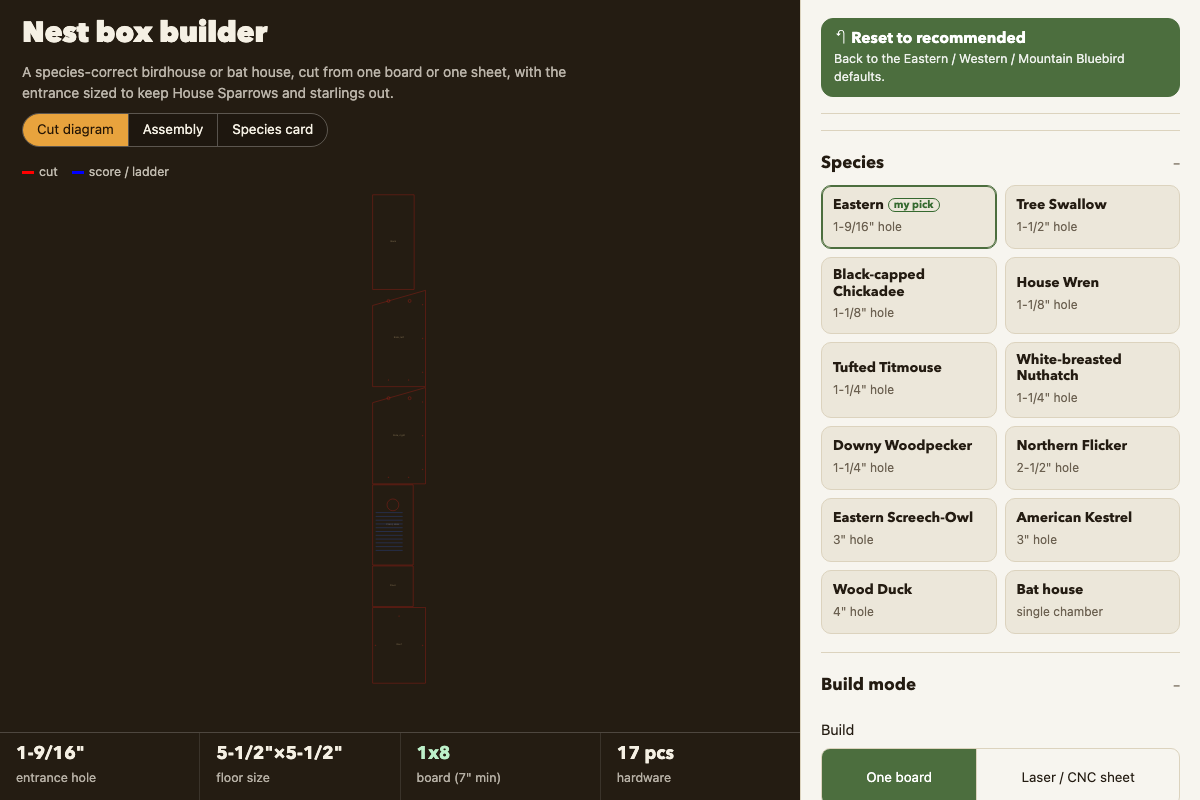
Screenshot of the tool as it opens; it is a real capture, not a mockup.
Thanks, your report was sent.
Report a problem or a newer version
What it makes
A printable PDF plan (a dimensioned cut diagram, numbered assembly steps, hardware list, a species card with the six key numbers and source citation, and a 1:1 entrance-hole template with a 50 mm check square) plus an SVG of the panels, either laid out along a 1x6/1x8/1x10/1x12 board for a table saw, or nested on a plywood sheet with finger joints for a laser or butt joints with screw holes for a CNC router. Twelve bird species and a single-chamber bat house are built in, each with the entrance size, floor, entrance height, depth, mounting height and habitat notes published by NestWatch, the North American Bluebird Society or Bat Conservation International, plus a note to check local/regional guidance.
How to use it
- Pick a species (Eastern Bluebird is the default) or the bat house from the Species list; the recommended entrance size loads automatically.
- Choose One board (the classic plan, cut to length along a single board) or Laser/CNC sheet (finger joints or butt joints with screw holes on 6 mm plywood).
- Check the Entrance and Box dimensions sections; the tool warns if a hole is large enough to admit House Sparrows or starlings, if the roof overhang is too shallow, or if the chosen board is too narrow.
- Set your planned mounting height and read the Species card view for habitat placement notes and the source citation.
- Download the PDF plan for the cut diagram, assembly steps and the 1:1 entrance-hole template, and the SVG for a laser or CNC file.
- Build with untreated wood only; score the fledgling ladder lines without cutting through, and hang the front panel on a single pivot nail so it opens for an annual clean-out.
Build notes
- Entrance sizes, floor dimensions, entrance heights, depths and mounting heights follow NestWatch (nestwatch.org/learn/all-about-birdhouses), the North American Bluebird Society, and Bat Conservation International's Bat House Builder's Handbook; sources are cited in the tool and in a code comment.
- Local conditions vary: check a state wildlife agency or local Audubon chapter before installing, especially for raptor boxes (Kestrel) or protected species (Wood Duck).
- Finger-joint geometry is generated for the back-to-side corners; the floor and roof are glued/screwed butt joints in both build modes.
- Works fully offline once opened; nothing is fetched.
Versions
The site runs the newest. Every earlier version stays downloadable, unchanged, for builds already under way.