Pedal enclosure drill template
Lay out a guitar pedal box, check clearances, print a 1:1 drill template
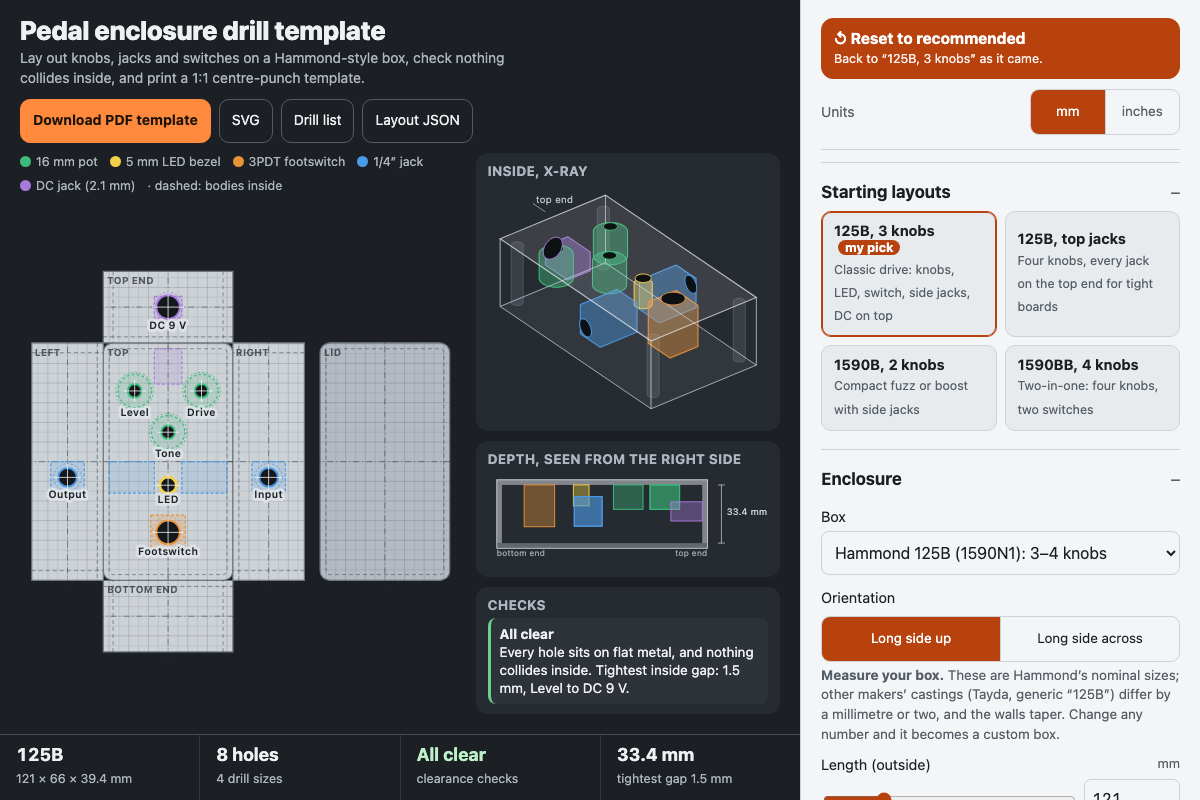
Screenshot of the tool as it opens; it is a real capture, not a mockup.
Thanks, your report was sent.
Report a problem or a newer version
What it makes
A printable, 1:1 drilling template for an aluminium guitar-pedal enclosure. Each face that has holes (and always the top) gets its outline, centre lines, a crosshair and punch dot at every hole, the hole diameter and part name, and orientation notes; every page carries a 50 mm check square and a print-at-100% warning, and faces too big for one sheet are tiled with 10 mm overlaps. Alongside it: an SVG of the unfolded box in millimetres (red holes, blue outlines, black marks) for a laser-cut paper stencil, a Markdown drill list with hole counts, positions and metric and imperial step-drill sizes, and a JSON layout you can load back in.
How to use it
- Pick a starting layout (the 125B with three knobs is the recommended default) or choose a box and add parts.
- Measure your enclosure and correct the length, width, height, wall thickness and corner radius if they differ.
- Drag holes on the unfolded box, or type positions measured from each face's centre; use Centre, Space evenly and Mirror copy to keep things symmetric.
- Clear every red check. The x-ray and depth views show which bodies collide inside and how close they come to the lid.
- Download the PDF, print it at 100% / Actual size, and confirm the check square measures 50 mm.
- Tape each face on, centre-punch every crosshair, drill a 3 mm pilot, open up with a step drill, and deburr.
Build notes
- Enclosure sizes follow Hammond's datasheets; other makers' castings differ slightly and the walls taper, so always measure the box you have.
- Part sizes are typical catalogue values: 12 mm for a 3PDT footswitch and DC jack, 9.5 mm for 1/4-inch jacks, 7 mm for pots, 6.35 mm for mini toggles. Cliff-style, Neutrik NMJ and open-frame jacks share the 9.5 mm hole but reach different depths inside.
- Inside clearance is checked with simple boxes and cylinders, including the lid-screw posts in the corners; leave a millimetre or two for wiring and the circuit board.
- Works fully offline once opened; nothing is fetched.